It's interesting how the future never unfolds the way we expect. I retired last August, and I had every reason to expect that cycling would become a much more common pastime. It certainly was for the first six months. Once winter settled in, however, other things began to fill in my list of daily activities. Alas, most of those things did not involve fitness or exercise. So, by the time green shoots of spring appeared, I had settled in to a sedentary pattern of life. While there have been bicycle rides in the past few months, I have not been able to include cycling on the scale I did it even a recently as six months ago.
I'm happy to report that most of these distractions are good things: we're arranging for a new kitchen, I'm working on my dissertation, and I just finished a nice cruise vacation with Robbie. So, unlike many folks my age, I have not been laid up by serious medical issues.
So, now that we've returned from our travels as a couple, and while our house is barely liveable, I've decided to drive across the country to Colorado, stopping at great rail trails along the way. What better way to reconnect with my favorite sport and provide grist for the blogmill. Starting next week, you'll be able to find photos of the 2013 Road Trip. You can expect views of ribbons of trail, rail-trail artifacts, and tunnels of trees. I expect it will all end with a ride up the Continental Divide in Colorado. By the time I get home, I expect the indoor air will be breathable again.
Until then, happy trails! - KWC
Saturday, June 8, 2013

Wednesday, April 10, 2013
My Published Articles
It may seem that I've been blogging lightly, but in actuality I've been writing and illustrating articles for the local bicycle club, the Potomac Pedalers. The club publishes a monthly newsletter, the Pedal Patter. Beginning with the February issue, I discuss a century a month. I try to choose an upcoming annual event, so that the reader still has time to do the ride when the article is published. For example, the May article (which I will post here shortly) discusses the Lobster Ride & Roll century in Maine in July. There's still plenty of time to set up the trip.
The pedal patter articles are available online, but there is sometimes quite a delay in posting them. I'll try to make each one a blog entry.
So, in my dreams, this all becomes a book. Would you buy such a thing? I would think that maps like this might be quite useful for those planning to do centuries.(I broke the formatting of the web page in order to publish a more readable map. Again, let me know if your browser doesn't like this.)
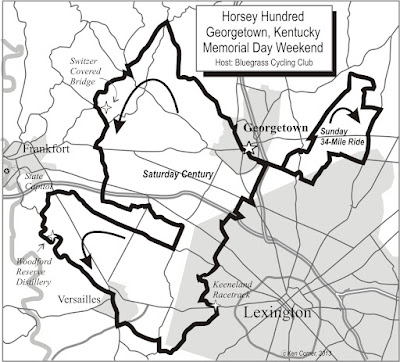
As for this specific ride, the Horsey Hundred is still an option for people reading this blog in April or early May. Lexington is a comfortable day's drive from most places in the Mid-Atlantic or Chicago. In fact, people come from long distances to enjoy a long spring weekend in horse country.
My article on the Horsey Hundred was published on page 14 of the March issue of the pedal patter.
The pedal patter articles are available online, but there is sometimes quite a delay in posting them. I'll try to make each one a blog entry.
So, in my dreams, this all becomes a book. Would you buy such a thing? I would think that maps like this might be quite useful for those planning to do centuries.(I broke the formatting of the web page in order to publish a more readable map. Again, let me know if your browser doesn't like this.)

As for this specific ride, the Horsey Hundred is still an option for people reading this blog in April or early May. Lexington is a comfortable day's drive from most places in the Mid-Atlantic or Chicago. In fact, people come from long distances to enjoy a long spring weekend in horse country.
My article on the Horsey Hundred was published on page 14 of the March issue of the pedal patter.
Monday, March 11, 2013
The Iditarod Invitational
I'm sitting at home in Virginia enjoying the web-based updates from Alaska. I became interested in the Iditarod during my Alaska bike tour last August. The annual event begins in early March and lasts about two weeks. It has a ceremonial start in Anchorage and really begins in Willow, just outside Wasilla. This year has a lot of drama, and as I write this the lead has changed several times in the past few days. I am in awe of all the mushers. The last place musher (the "Red Lantern" sled) is Cindy Abbot of California. Cindy was diagnosed with a rare disease (Wegners Granulomatosis) in 2010. Since then has climbed Everest, finished the Yukon Quest 300, and is well past the half way mark on the Last Great Race. Her website is aptly named http://reachingbeyondtheclouds.com/.
There's a bicycle connection as well. The Iditarod Invitational is a human-powered race (runners and snow-bikers) along the first 350-miles of the Iditarod trail. This year's race was by far the fastest, with numerous records broken.
There is an opportunity for truly experienced athletes to continue along the entire trail to Nome, a distance of 1000 miles. This year three cyclists are on the course still, attempting the run to Nome.
While the cyclists get a week head start, they are normally lapped by the speedier mushers. (This brings new meaning to the phrase "chased by dogs"!) Even with a snow bicycle, there's a need to walk in deep snow or slush or water. Right now, Anchorage cyclist Bob Ostrom is in the lead, and is approaching the Bering Sea "Gold Coast".
All these people have a different concept of cold. "Too warm" is anything above zero. "Just right" is about ten below. And, yes, we are talking Fahrenheit! Alaska has some tough people!
There's a bicycle connection as well. The Iditarod Invitational is a human-powered race (runners and snow-bikers) along the first 350-miles of the Iditarod trail. This year's race was by far the fastest, with numerous records broken.
There is an opportunity for truly experienced athletes to continue along the entire trail to Nome, a distance of 1000 miles. This year three cyclists are on the course still, attempting the run to Nome.
While the cyclists get a week head start, they are normally lapped by the speedier mushers. (This brings new meaning to the phrase "chased by dogs"!) Even with a snow bicycle, there's a need to walk in deep snow or slush or water. Right now, Anchorage cyclist Bob Ostrom is in the lead, and is approaching the Bering Sea "Gold Coast".
All these people have a different concept of cold. "Too warm" is anything above zero. "Just right" is about ten below. And, yes, we are talking Fahrenheit! Alaska has some tough people!
Friday, January 25, 2013
Mission Complete!
Kohala Coast, HI. Well, the odometer reads 100 in my fiftieth state and, coincidentally, my 50th blog entry! I've completed circumnavigating the big island of Hawaii, and I celebrated with a swim in the Pacific Ocean -- my first. Our last day of riding in a week-long trip was along the Ironman course (but at a distance far short of the 112-mile monster). I chose to join a trip run by Backroads, an adventure travel company, which specializes in bicycle adventures around the world. Alaska was also accomplished on a Backroads tour.
 I saw: black sand beaches, coffee plantations, rainbows, whales, an active volcano's glowing lava pool, the southernmost bakery in the United States, donkeys, huge macadamia nut farms, rain forests, miles of lava fields, mongoose, native temples, dugout canoes, and waterfalls.
Our group of twelve cyclists -- all strangers before -- representing all ages and skills quickly formed an amazingly warm connection. We laughed heartily and well throughout the day from the pre-cycling circle to the open air dinner. None of us wanted this to end! (Of course who would, given the fact that much of the US experienced an Arctic blast in our absence.)
As for the cycling in Hawaii, I must report that the state leaves a lot to be desired. While the views are spectacular, the roads have many flaws. There were several times that the safety margins disappeared and the risks grew much too great for my practiced eye. I would never lead a bike ride along some of the roads that we traveled this week. In addition, the surprisingly large amount of glass on the highway kept the Backroads pit crews busy changing tires. I had two flats myself.
 The photographs, of course, represent those quiet moments on the relatively few backroads that could be found. In heavy traffic, with little shoulder on broken pavement one would never stop to take a picture!
But it's done! I'll be back for a project wrapup soon. And, yes, I realize I will have to be developing a set of links to the 2013 centuries. So much to do, and so little time until bicycling season!
 I saw: black sand beaches, coffee plantations, rainbows, whales, an active volcano's glowing lava pool, the southernmost bakery in the United States, donkeys, huge macadamia nut farms, rain forests, miles of lava fields, mongoose, native temples, dugout canoes, and waterfalls.
Our group of twelve cyclists -- all strangers before -- representing all ages and skills quickly formed an amazingly warm connection. We laughed heartily and well throughout the day from the pre-cycling circle to the open air dinner. None of us wanted this to end! (Of course who would, given the fact that much of the US experienced an Arctic blast in our absence.)
As for the cycling in Hawaii, I must report that the state leaves a lot to be desired. While the views are spectacular, the roads have many flaws. There were several times that the safety margins disappeared and the risks grew much too great for my practiced eye. I would never lead a bike ride along some of the roads that we traveled this week. In addition, the surprisingly large amount of glass on the highway kept the Backroads pit crews busy changing tires. I had two flats myself.
 The photographs, of course, represent those quiet moments on the relatively few backroads that could be found. In heavy traffic, with little shoulder on broken pavement one would never stop to take a picture!
 But it's done! I'll be back for a project wrapup soon. And, yes, I realize I will have to be developing a set of links to the 2013 centuries. So much to do, and so little time until bicycling season!
Saturday, December 8, 2012
Rounding Out 2012
Sebring, FL. It's a rainy Saturday evening as I just completed the long ride of the three-day Highlands Bicycle Festival. The local bike club puts on this festival every year in early December. It's a great opportunity for us Northerners to extend the season by a few weeks. Today's ride was a sunny 80 degrees with billowing clouds and light winds. Florida was reliably flat -- although the locals had some up-ramps that they call hills. This brings to a close my most successful cycling year, yet.
But, let me update the project. Shortly after the No-Hill Hundred in early October in Nevada, I completed a century along the Mississippi River Trail in New Orleans. The levee makes a nice, quiet cycling environment, although it is somewhat lacking for shade. There are wonderful views of the shipping -- large and small -- moving along the Big Muddy. The trail ends in the western reaches of downtown New Orleans, so I had a chance to ride among the famous streetcars. The ride also provided a sampling of much of the heavy industry along the Mississippi shore, from grain elevators to oil refineries, and the rail lines that serve them. The small towns and plantation houses, many of which grew up as river landings before a levee separated them from the river, seem to cling to a tenuous existence.
And the immense hydraulic potential is evident just to the north of the trail, as the gigantic mile-wide Bonnet Carre Spillway stands ready to divert the Mississippi into Lake Pontchartrain. It strains the imagination to consider a river this large needing an additional river-size spillway to handle a flood. But, we're talking about all the precipitation from Pittsburgh to Denver and everything in between, so there's half a continent's worth of watershed to account for.
Thus, Louisiana became state number 48.
In late October, I enjoyed the second annual Longleaf Trace Century in Hattiesburg, MS. This 'trace' is an award-winning rail-trail that runs some 40 miles to the west of Hattiesburg. It is the crown jewel in a network of greenways in this university town. The Trace shares the same feature of most rail-trails: it is flat. But, to add enough miles to make the ride a century, the organizers added a little off-the-trail spice to the mix. So, while the trains of old enjoyed a well-graded right of way, the surrounding terrain undulates. This in-the-wild section was in the middle of the ride, so the beginning and end provided no surprises.
And, with Mississippi, I now have 49 states.
 |
| Mississippi River Trail, New Orleans, LA |
And the immense hydraulic potential is evident just to the north of the trail, as the gigantic mile-wide Bonnet Carre Spillway stands ready to divert the Mississippi into Lake Pontchartrain. It strains the imagination to consider a river this large needing an additional river-size spillway to handle a flood. But, we're talking about all the precipitation from Pittsburgh to Denver and everything in between, so there's half a continent's worth of watershed to account for.
Thus, Louisiana became state number 48.
In late October, I enjoyed the second annual Longleaf Trace Century in Hattiesburg, MS. This 'trace' is an award-winning rail-trail that runs some 40 miles to the west of Hattiesburg. It is the crown jewel in a network of greenways in this university town. The Trace shares the same feature of most rail-trails: it is flat. But, to add enough miles to make the ride a century, the organizers added a little off-the-trail spice to the mix. So, while the trains of old enjoyed a well-graded right of way, the surrounding terrain undulates. This in-the-wild section was in the middle of the ride, so the beginning and end provided no surprises.
And, with Mississippi, I now have 49 states.
Saturday, October 6, 2012
A Century On the Ground
Fallon, NV. (Oct. 6, 2012) Today, I finished the No Hill Hundred, a pretzel-shaped ride through the paved byways of the high Nevada desert. It was sponsored by the Churchill County Cyclists and the Churchill County Parks & Recreation. Fallon is the home of a Naval Air Station (famous for its Top Gun school), and deems itself the "Oasis of Nevada". It's located at the junction of US routes 95 and 50. As you can tell from the satellite image, they have a good nickname. This is anything but barren desert.
 The terrain delivered as promised: there were truly no hills. Of course we did ride mile after mile in the same gear, but that was a small price to pay. The route was well-marked, and the rest stops well-stocked. This is their tenth year running a century in flat Fallon.
Fallon is at 4000 feet of altitude. I think that took a little edge of my riding pace. I found myself out of breath if I took too long a drink while riding. It's hard to get acclimatized when you fly in two days before!
October is a comfortable time of year to ride in northern Nevada. The temperature peaked in the 70s, but the ride began at about 40 degrees. The air was so dry, however, that you could ride with just a light covering. There is even some color-shifting foliage here. The brush turns yellow and the trees get some color. There is one plant that gives off a delicious smell, but I could never identify it. That's one of the benefits of riding a bike instead of driving a car.
 Of course, being able to smell the environment can also be a disadvantage. Livestock stink. And, cattle seem to stink the worst. I remember pedaling a little faster to get out of the plume!
Horse farms abound. There were stables, horses, and trucks with horse trailers. What I never saw, however, was a single person riding a horse! As we rode past the corrals, the horses would watch us enviously.
This is Top Gun country. You are greeted by an A-7 (carrier-based attack aircraft, no longer in use) on a high pedestal. The course in fighter tactics, made famous by the Tom Cruise movie, was originally located in Miramar, California. It moved to Fallon Naval Air Station in 1996 to become part of the Naval Strike and Air Warfare Center. East of Fallon, the Navy operates an instrumented "range", where the airspace is digitally monitored. I think we passed several of the monitoring stations along the way. There are only four courses a year, so the chances of seeing any combat aircraft on an October Saturday are slim. In fact, even though we circumnavigated the Naval Air Station, we saw no activity at all.
On the day of the ride, Fallon becomes home to a completely different kind of 'gunslinger'. The Cowboy Fast Draw Association runs the World Championship - Fastest Gun Alive contest in Fallon on the same weekend as the century. So, the hotel lobby was an interesting mix of people dressed in old western gear (gunslingers need realistic townspeople in the background!) and colorful spandex-clad cyclists.
For those of you who have lost count (and who hasn't??), this is state number 47. Three more left to go!
I only put the best pictures on this blog. I will add to the Webshots archive of bike photos, including a picture of the rest stop under the A-7, the sluice gates for irrigation, the only hill in town, and the start and finish arch, later this week.

Fallon is at 4000 feet of altitude. I think that took a little edge of my riding pace. I found myself out of breath if I took too long a drink while riding. It's hard to get acclimatized when you fly in two days before!
October is a comfortable time of year to ride in northern Nevada. The temperature peaked in the 70s, but the ride began at about 40 degrees. The air was so dry, however, that you could ride with just a light covering. There is even some color-shifting foliage here. The brush turns yellow and the trees get some color. There is one plant that gives off a delicious smell, but I could never identify it. That's one of the benefits of riding a bike instead of driving a car.

Horse farms abound. There were stables, horses, and trucks with horse trailers. What I never saw, however, was a single person riding a horse! As we rode past the corrals, the horses would watch us enviously.
This is Top Gun country. You are greeted by an A-7 (carrier-based attack aircraft, no longer in use) on a high pedestal. The course in fighter tactics, made famous by the Tom Cruise movie, was originally located in Miramar, California. It moved to Fallon Naval Air Station in 1996 to become part of the Naval Strike and Air Warfare Center. East of Fallon, the Navy operates an instrumented "range", where the airspace is digitally monitored. I think we passed several of the monitoring stations along the way. There are only four courses a year, so the chances of seeing any combat aircraft on an October Saturday are slim. In fact, even though we circumnavigated the Naval Air Station, we saw no activity at all.
On the day of the ride, Fallon becomes home to a completely different kind of 'gunslinger'. The Cowboy Fast Draw Association runs the World Championship - Fastest Gun Alive contest in Fallon on the same weekend as the century. So, the hotel lobby was an interesting mix of people dressed in old western gear (gunslingers need realistic townspeople in the background!) and colorful spandex-clad cyclists.
For those of you who have lost count (and who hasn't??), this is state number 47. Three more left to go!
I only put the best pictures on this blog. I will add to the Webshots archive of bike photos, including a picture of the rest stop under the A-7, the sluice gates for irrigation, the only hill in town, and the start and finish arch, later this week.
Wednesday, September 26, 2012
Blogging is Light When the Weather is Great
Springfield, VA. I just got back from a mid-day, mid-week bike ride through a nearby park. I enjoyed 32 miles of quiet park paths or neighborhood streets abandoned for the dungeons of work and school. It was a sunny 65 degrees with light winds. There is a hint of color in the foliage this first full week of fall. September is a great month to be retired!
Although I've acquired no states since my trip to Wisconsin, I've been able to ride a century for both of the past two weekends. On the 16th I drove up to Carlisle, PA to enjoy the Three Creek Century, an annual offering of the Harrisburg Bicycle Club. I must say, I took my time because the weather was so nice and the scenery was so pretty.
Last weekend was our own bicycle club's century. The Potomac Pedalers offers the Back Roads Century in Berryville, VA. I helped out with preparation on Saturday so that I could do the ride on Sunday. The day was a perfect copy of the previous week. Again, I lingered at the White Post rest stop, munching on the club's famous 'tomato sandwiches'. (I had loaded the pallets of said tomatoes onto the truck the previous day, so this was the fruit of my volunteer labor!)
With all this nice weather it's becoming obvious why, years ago, the League of American Wheelmen, designated September "National Century Month". This was, of course, back when the LAW sanctioned, supported, and helped to organize centuries. Now there is no national century organization.
This is all prologue, however, to my upcoming frenzy of states. This coming weekend I'll hit state #47, Louisiana, with the Crescent City Century. The following weekend, I'm booked for state #48, Nevada -- the "No Hill Hundred". Somebody asked me if that was sarcasm, and if the ride had a lot of hills. I had not thought of that! I'm going to be checking the website and the map profiles.
And, on Saturday, October 27, I plan to collect state #49, Mississippi. The 'Longleaf Trace', a large rail-trail near Hattiesburg, offers their second annual century ride. That will color in the continental US red from sea to sea and border to border.
Hawaii will be left. I'm in the process of booking a Backroads bicycle tour of the big island in January. After that there's nothing to do but write the book!
Although I've acquired no states since my trip to Wisconsin, I've been able to ride a century for both of the past two weekends. On the 16th I drove up to Carlisle, PA to enjoy the Three Creek Century, an annual offering of the Harrisburg Bicycle Club. I must say, I took my time because the weather was so nice and the scenery was so pretty.
Last weekend was our own bicycle club's century. The Potomac Pedalers offers the Back Roads Century in Berryville, VA. I helped out with preparation on Saturday so that I could do the ride on Sunday. The day was a perfect copy of the previous week. Again, I lingered at the White Post rest stop, munching on the club's famous 'tomato sandwiches'. (I had loaded the pallets of said tomatoes onto the truck the previous day, so this was the fruit of my volunteer labor!)
 |
| Carlisle, PA |
This is all prologue, however, to my upcoming frenzy of states. This coming weekend I'll hit state #47, Louisiana, with the Crescent City Century. The following weekend, I'm booked for state #48, Nevada -- the "No Hill Hundred". Somebody asked me if that was sarcasm, and if the ride had a lot of hills. I had not thought of that! I'm going to be checking the website and the map profiles.
And, on Saturday, October 27, I plan to collect state #49, Mississippi. The 'Longleaf Trace', a large rail-trail near Hattiesburg, offers their second annual century ride. That will color in the continental US red from sea to sea and border to border.
Hawaii will be left. I'm in the process of booking a Backroads bicycle tour of the big island in January. After that there's nothing to do but write the book!
Subscribe to:
Posts (Atom)